
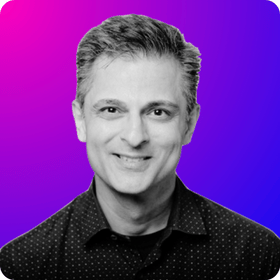
Muhammad and his team at Unity Health are doing transformative work by combining on-the-ground clinician insights with the power of AI. This “living lab” where the problems to be solved are brought by end-users, solutions are informed by combined years (and years!) of data, and applications are iterated in partnership with end-users has delivered astounding results. Muhammed has a knack for taking the very complex and making it accessible, something he does both in his work and also in this episode.
Thank you to our Season 1 partner Papercurve. To find out more about how Papercurve can transform your content review and creation process, visit www.papercurve.com.
This episode was produced by Darryl Webster with Chess Originals.
[00:00:01] We'd like to be that center that says, here's what the art of the possible is. If you could dream, if you could make patients' lives better in a way that nobody else has,
[00:00:11] here's a proof point that we're able to show the rest of the world in terms of how you can do it. So where we believe the future to be is in multimodal AI. Welcome to the PharmaBrands Podcast brought to you by PaperCurve. I'm your host, Neil Fallon.
[00:00:28] Today I'm talking with Muhammad Mamdani, and I am really excited to share this conversation with you. Muhammad is a team that is doing unbelievably transformative work at Unity Health here in Toronto. The impact on patient care, outcomes, and workflows is frankly quite extraordinary.
[00:00:46] To get these results, Muhammad is deploying AI and using data scientists, all really cutting-edge stuff, but just as importantly, he's listening. The solutions that his team develops are driven by clinicians who are dealing with patients and hospital staff every day.
[00:01:04] And this combination of technology, data, and human experiences is the living lab within which some pretty magical work is happening. Let's get on with the show. Muhammad, thank you for joining us today. Pleasure. Let's start with a bit of background. Where did you start on this whole journey?
[00:01:22] What's your educational background? Give us a little bit about yourself to start. My background is actually very, very mixed. I'm actually trained as a clinical pharmacist. I have a doctor of pharmacy or a PharmD degree from the University of Michigan in Ann Arbor.
[00:01:36] And at the time what was kind of a big thing was around resource allocation and health economics and that sort of stuff, which is still pretty, pretty important today. So I decided I wanted more formal training in health economics.
[00:01:51] So I went and did a fellowship at the Detroit Medical Center in Pharmacoeconomics and Outcomes Research. And it was an interesting experience, but I wanted some more formal training. So the fellowship experience was wonderful for practical things.
[00:02:06] But at night I took classes at Wayne State University and worked towards getting a master of arts degree in econometric theory of all things. So this is heavily quantitative, very math oriented. And it was wonderful, it was a wonderful experience.
[00:02:22] It was quite a bit of mathematical proof writing and all that sort of stuff. But I needed something that was a bit more contextual to health care. So I went to Harvard to do a master's degree, a second master's degree, this one in public health,
[00:02:36] where they focus on quantitative methods essentially meaning statistics and epidemiology. And at that point, I think I had a pretty rounded experience in terms of the clinical side of things as well as the quantitative side of things.
[00:02:47] And then moved to Toronto to work at the Institute for Clinical Evidence Sciences, or now known as ICES at Sunnybrook Health Sciences Center. I actually did clinical work at Sunnybrook and research at ICES.
[00:03:03] And I basically learned how to code with a lot of help from colleagues and coded for almost a decade to really kind of say, all right, well, how do I actually leverage the incredible data that's at this research institute to glean insights from a research standpoint.
[00:03:18] And being trained in epidemiology, I used more traditional methods and found there were a lot of limitations in the more traditional methods. The evidence hierarchy in medicine suggests that randomized trials are among the best quality of evidence that you can do.
[00:03:31] So eventually I actually started up a clinical trial center called the Applied Health Research Center at St. Michael's Hospital. And still again, when you look at randomized trials, there's lots of limitations on those sorts of studies as well,
[00:03:44] which then maybe gravitate towards something that was a bit more nuanced, a bit more personalized. And that's where artificial intelligence came into play. And now I lead a team of 30 people who are dedicated to the development and deployment of advanced analytic solutions.
[00:04:00] The majority of them using AI machine learning to drive meaningful changes in patient care and hospital processes. When you were a kid, so I'm going all the way back now.
[00:04:13] When you were a kid, what were you really interested in? Were you a math kid? Were you a science kid? Yeah, when I was a kid, I was really into the maths and sciences. The whole STEM thing just really resonated with me.
[00:04:25] In fact, I remember I was in art class and my art teacher was just wonderful. She was very hands-on and I was never really good at art, but I thought there was one exercise with clay.
[00:04:40] And I thought, wow, this is fantastic. I think I'm really good at this. I actually made this when I thought it was a deer out of this clay. It was a deer sculpture.
[00:04:48] And I called over my teacher and I was really excited to show her, like look at this wonderful creation. And she looked at it and said, oh, that's a wonderful beaver. And she quickly kind of started putting her touches on it.
[00:05:00] And I thought, well, yeah, this is not my space. Let's just stick with the math. Yeah. Interesting anecdote about being an art class, because if we fast forward to now, what you and the team are doing, which I really want to dig into because there's one that's fascinating
[00:05:15] and it's delivering unbelievable results. Thank you. But being on the vanguard of what you're doing right now, there is science to it, but there's also a bit of art to it because you are out ahead and you're not necessarily following in footsteps.
[00:05:28] Our previous conversation, I had asked you, so who else do you look to in Canada or around the world who's doing the kind of work you're doing? And your answer was there's not a lot of us.
[00:05:39] Yeah, it's rather unfortunate because people go in and they say look for benchmarks. And I think in this sort of space, you quickly realize when you are the benchmark because you're heading into waters that have been uncharted
[00:05:56] and you have to be bold and brave enough to say if there aren't standards, we'll create them. And if we're wrong, that's OK. We have to have the courage to say we'll revise those standards. But it is a learning process and an openness to risk
[00:06:13] to doing things that simply others haven't done. So let's talk about what you're doing that others haven't done. But before we get there, for those listeners who aren't aware, talk a little bit about Unity Health. Yeah, Unity Health is a composition of three health centers in Toronto,
[00:06:29] namely St. Michael's Hospital in downtown Toronto. We're a level one trauma center, acute care academic teaching hospital. The West End, we have St. Joe's or St. Joseph's Health Center, which is a community hospital with a very busy emergency department.
[00:06:46] And on the East End, we have Providence Health Care, which is a long term care rehab facility. So the three organizations have come together to form Unity Health Toronto. Which is interesting when I think about you've got long term care,
[00:07:01] you've got St. Joe's is a really big community hospital and trauma and acute care. You're getting very interesting data points from a bit of a 360 degree view. What are you and the team doing with the data and talk about some of the projects you've got ongoing?
[00:07:18] Yeah, I think the unique thing about Unity Health are I think two things that are really interesting. One is that cradle to grave concept, right? That we see a whole variety of patients throughout the entire spectrum. The other thing that makes Unity really unique
[00:07:32] is that we're the only healthcare organization in the country that I know of that has declared AIs a core strategic pillar. So we have nine strategic pillars, three of them are core strategic pillars. AIs one of those core pillars,
[00:07:44] which means that we put a lot of effort and resource into it. And from the board of directors to the CEO throughout the entire organization, AI is a priority for us. So what does our team do? We have a very simple model.
[00:07:59] And again, this is based on what made sense to us. We didn't really see any benchmarks or any standard ways of doing this internationally that have been successful. So we created it. It's very much an AI living lab and user first concept. What do we mean by that?
[00:08:14] We mean that a lot of people in this space play in the research side of things. So isn't this a cool research project? Let's actually research it wonderful. That's great. You do some data analytics work. Come up with a good model. You publish a paper and you're done.
[00:08:28] We wanted something much more. And we really revolved around a famous quote by Einstein, which says, if I had one hour to solve a problem, I would spend 55 minutes understanding the problem and five minutes developing the solution. And we stepped back and we thought,
[00:08:44] if we're trying to solve clinical problems, who understands them? It's not going to be the researcher typically. It's not going to be the data scientist. It's going to be the people who are seeing the patients every day or making administrative decisions, who are basically in it.
[00:09:00] They live and breathe this stuff every day. That's who should be driving the solutions we create. So we fully embrace end users who struggle with problems day in and day out and say, please help us. Let's work with you. Let's develop a solution to make your lives easier.
[00:09:17] That's really the model that we have. So we don't care what you're searching for. What's that kind of adoption curve been like? And I don't even mean adoption for the solutions that you're developing, but adoption of folks saying, oh, I get it. I'm buying into this pillar.
[00:09:35] I'm going to put my hand up and say, hey, maybe this is a problem that you and your team and the AI can solve. Because I imagine in the early days, you might have those folks who have sort of the time or the inclination to be saying, hey,
[00:09:47] I'm going to engage with Mohammed's team. But over time as programs roll out and you start to see real results in the workflow and the clinical side of things, you are likely getting far more requests than you did initially for support. What has that looked like?
[00:10:03] Because there must be a different type of triage process that your team must do now that you're probably hitting a whole bunch of momentum and scale. Yeah, yeah. Actually we've developed and deployed over 50 solutions into clinical practice.
[00:10:17] And currently we do have a lot of demands on our end users because again, they understand the problems better than anyone else. So we require that they actually attend meetings regularly. You really truly co-create with us. And we thought, wow, that's a lot of pressure
[00:10:31] we're putting on busy clinicians, busy administrators. Just people who just have a lot of demands on their time. Right now we have over a one year wait list on projects. So the demand has been incredible because again, we're very focused on how do you deploy,
[00:10:47] develop and deploy AI solutions that deliver results? So let's get into an example of an AI solution that was generated from a need that an end user brought to you that you're starting to see results on. Yeah, absolutely. I think the one we usually quote
[00:11:05] or talk about quite a bit is chart watch. An internist Dr. Mulvara who's a brilliant internist came to us and said, one of the key reasons why people come to a hospital is to not die. And that's a really good goal to have.
[00:11:19] So we tend to have a bit of a rigorous lens on this and said, all right, well, tell us a little bit more about this. Why is it that people die? And the response was, well, actually, we've done an audit.
[00:11:31] We've looked at people who die in the internal medicine unit. And what we find is there's quite a few patients who will die no matter what we do. It's inevitable. But there are also quite a few patients who had we known earlier,
[00:11:44] if we paid maybe a little bit more attention, maybe we could have actually prevented that death. And that's the concerning part. It's tough as clinicians, right? The average internist will spend, and I think I'm being very generous here, maybe 10 minutes a day face to face with a patient.
[00:11:59] The rest of the time, they're doing, they're working on patients, they're fighting fires, they're doing administrative work. They have a lot of responsibility on their hands. As clinicians, I think we do some basic things, diagnose, prognose, and treat. But it is very, very time consuming.
[00:12:13] So the thought was, is anyone really sitting there saying, hmm, I wonder what happened over a three day period in terms of trans and their hemoglobin level and these other 200 parameters I'm monitoring? Nobody has the time to do that.
[00:12:26] If we were to know in advance who's going to die or go to the ICU, and something triggered us to say, this patient's gonna be in trouble, then we can actually really reorient our attention to that patient. So the ask was, can you develop an AI solution
[00:12:45] that will predict who's going to die or go to the ICU in the next 48 hours and let us know in advance so we can actually pay more attention to that patient? So that's what chart watch is. It's basically an early morning system.
[00:12:57] The spoiler here is that the results are quite staggering. But before we get to the results, talk a little bit about how something like that comes to life. So you've got the genesis of it is, we obviously want better clinical outcomes.
[00:13:10] We want people to come into the hospital and not die. You've got a whole ton of data. How do you start to unpack this? What does the team look like? What's the kind of deployment time? Is this a phase deployment?
[00:13:23] Like give a sense of how something like this comes to life. I think we think about things in terms of two core teams. The first is more on the technical side. So we have a data science team. As I mentioned, it's about 30 people.
[00:13:38] And the second team is on the clinical side. So this is where we have our doctors, our nurses, our residents, our physiotherapists, our pharmacists, whoever on the clinical side. The two now start coming together and start learning from each other. And that's really critical for us
[00:13:52] because when the clinicians come up with the problem, we have to then go back and say, all right, if we're going to develop a machine learning model, what data do we need to feed that machine learning model? How are we getting that data?
[00:14:03] Where are we getting the data from? How are we cleaning the data? How are we actually processing it through machine learning algorithm, spitting out the results and feeding it back to the clinicians all in a timely manner to impact clinical decision making.
[00:14:17] So the technical side is headed up by our data science team. And we have four sub teams within the data science team all the way from data engineering to model development to solution creation around people of expertise and design and human factors to change management
[00:14:33] and human psychology and education around how you actually then translate this into practice. They handle a lot of those sorts of aspects and then of course the clinical team to say, all right, look, here's the reality of my workflow. I actually round during this time
[00:14:49] and if you have this many false alarms and you ping me with my crying wolf X number of times, I'm just going to ignore the alarms. I need this algorithm to perform this way and on my terms for me to be able to use it effectively.
[00:15:05] Having an understanding of the clinical side, the workflow, all the pressures they have is critical to then developing AI solutions that will then actually have impact because it considers all the challenges in the workflows of hand users. When I think about a room full of data scientists
[00:15:24] and I think about a room full of clinicians I imagine there's a middle in that Venn diagram in terms of what everybody's trying to achieve but there's different language. There is different ways of talking about outcomes. Those two cohorts of individuals are doing two very, very different jobs
[00:15:40] and need to come together really effectively to produce chart watch or a new platform or solution. How well do those two quite disparate groups communicate with each other? Yeah, I would say traditionally very poorly. Okay, so it wasn't off on my question.
[00:15:57] Oh, it's a great question because, you know, I mean to be frank, like if a data scientist said to a neurosurgeon, all right, so let's talk about precision and recall parameters and let's then get into feedback on the issues that neurosurgeons are going to go,
[00:16:10] I have no idea what you're talking about. Yeah. And of course, if the neurosurgeon says, well, all right, so you know, here's what I'm going to do with this, with his aneurysm and there's a dissection here or something to that effect and the data scientists will say,
[00:16:22] I can barely pronounce what an aneurysm is but what is that? So you have these kind of barriers in understanding each other. Yeah. And the way we typically structure things is very much multidisciplinary team approaches to things. So typically what happens is when a clinician says,
[00:16:40] here's a problem I'm trying to solve. We say, all right, great. Let's go through in detail that problem and when you meet with our data science team, give us a med school 101. Tell us about, I'm going to look at, I'm going to use the Char watch example.
[00:16:55] Tell us about what a typical internal medicine patient looks like. Tell us about why people die. What are the key drivers? Give us a little bit of information on things that you worry about. What sort of lab values to look at? Why do you look at them?
[00:17:08] Give us a sense of pathophysiology and epidemiology. So it's almost like an education on the clinical side of things for our data scientists. Now, our data scientists take all that information back and say, oh, I get it. This is what drives let's say,
[00:17:22] you know, why you're concerned about this thing called the human hope model. They then take that back and say, for this problem, I think we're going to need let's say an XG boost or this type of machine learning model. The next session,
[00:17:34] we sit with the clinicians and say, we're going to give you a machine learning 101. Here's what an XG boost is. Here's how it's structured. Here's what it does. Here are the limitations. Here are the types of parameters that will come out of the model
[00:17:46] and this is why it's relevant to you. And so we start learning from each other our different languages our different understandings of the world or perceptions of the world in which we live. And over time, we really kind of the clinicians become much more literate in AI
[00:18:02] and the data scientists become much more literate in clinicalness. Are the clinicians, is there any, I don't know the right word. I'm going to say, you know, are they threatened by an AI platform that may diagnose more effectively than they can? Or is the just the obvious
[00:18:20] if we can just get a better diagnosis, it's another tool. We're going to adopt that as quickly as possible. That change management kind of piece. How does how much does that factor into it? Yeah, I think certainly there will always be people who feel threatened,
[00:18:33] but I think the overwhelming set of sentiment that we have, I think is actually quite positive. And the reason why is because we tend to tackle problems where people are so desperate for solutions and most of our healthcare professionals they're overworked, they're overburdened. They're stressed out.
[00:18:54] And so anything that can help them is typically very well received. And we also go through an exercise around well, why are you coming to us? Why is the problem so bad? Clearly there's something that you're struggling with. And if we can help you alleviate that,
[00:19:11] I think that's a win for everybody. Absolutely. Speaking of a win for everybody, talk a little bit about the impact of chairwatch because the results are quite spectacular. Yeah, we've been quite happy. And again, the model what it does is it runs every hour on the hour.
[00:19:28] So it's all automated and nobody has to enter anything or do anything. It takes data that already exists. It typically considers I believe 150 to 150, 150 to 170 parameters when it actually does its risk assessment. It categorizes each individual patient as low, medium and high risk
[00:19:48] for the event of dying or going to the ICU in the next 48 hours. As soon as it reaches a high risk threshold, all determined by our clinical end users, it's automated to page the medical team. And our protocol at St. Michael's Hospital
[00:20:00] is the medical team has to come and see the patient within two hours of being paged. And there's all sorts of care pathways. You look for signs of sepsis and consider initiating antibiotics. Do you increase monitoring to every one or two hours? We deployed this in October of 2020
[00:20:17] and we've submitted a paper for publication now. We've been able to document a 26% reduction in unplanned mortality. And it's been driven by our clinicians and that's why we've had success with it. We'll be right back after this message from Paper Curve. Season one of the Pharma Brands podcast
[00:20:36] is brought to you in part by our partner Paper Curve. Fast and efficient content review and approval is at the core of Paper Curve, but the platform does so much more. CRM verified emails, real-time collaboration and editing of all MS Office formats,
[00:20:53] managing approved product claims with the help of AI, linking external documents also with the help of AI, hassle-free sharing of reviews without the need for extra licenses or logins, structured content authoring with pre-approved text. I could go on. I really, really could.
[00:21:10] All of this for much less than the competition, with one week set up and dedicated support by real, live human beings. Find out how you can fall in love with your content reviews at Paper Curve.com. Now back to the show. And a 26% reduction in unplanned mortality
[00:21:30] is a staggering number to me. It probably in a category that exists on its own, you know, save for the advent of some transformative medicine or a transformative procedure, like that is an absolutely material and astounding result. Well, we think so. We think so.
[00:21:52] And I think it's not a new medicine or anything. It really deals with a few issues that I think clinicians struggle with. One is cognitive load. The second is timeliness. What do I mean by that? I think from the cognitive load perspective,
[00:22:09] when we consider all of the things that clinicians have to think about when they're trying to prognosticate, because this is really what they're trying to do. They're trying to prognosticate here. It's a lot of variables that go into their heads. So what are the things we consider?
[00:22:24] We consider things like social history, family history, laboratory values, medical imaging results, signs and symptoms. All these parameters have to be considered. And if we try to quantify it, there is actually some literature out there that suggests that the average medical decision, complex medical decision,
[00:22:42] involves considering hundreds of parameters. And I think there's one that's been quoted. I don't know if I've seen this study for this, but about 1,000 parameters for a very complex medical decision. And if we step back to human capacity, in the 1950s, there was a famous psychologist named Miller
[00:22:58] who was able to show us that the average human can process seven plus or minus two things at the same time. So of course we're going to struggle. And we've been able to show this actually. We, at our own institution, have published a study
[00:23:10] where we've actually went to the floors and we've asked our doctors, nurses and our residents, this is not a hypothetical case. You know this patient, you just finish rounding on this patient, tell me if they're going to die or go to the ICU.
[00:23:23] And we collected over 3,000 clinician predictions. We were able to show that when a physician says, this patient, yes, they're going to die or go to the ICU. They're right less than one third of a time. So we're not good at this. And not good means energy directed at
[00:23:39] potentially the wrong patients, resources misallocated, you know, not the kind of outcomes that obviously the hospitals and families are looking for. The import of not great at that is pretty significant in this category. Absolutely. And imagine this AI algorithm really considering all the complexities of those parameters
[00:23:59] every hour on the hour, every day 24 hours a day, seven days a week, that can be impressive. And in fact, like to your other point, what we didn't intend, it was a surprise to us in terms of how the nurses were using CharWatch.
[00:24:14] The nurses came back to us and said, this is a great tool. Yes, okay, fine. I can predict if somebody's going to die or go to the ICU. But what's really important for us is in the past, our nurses used to complain that this nurse
[00:24:28] has all the hard patients. This one's got all the easy patients and we don't really know how to allocate the patients effectively to our nurses. Well now we have a rule. A nurse cannot have any more than two high-risk patients. How do we know they're high risk?
[00:24:42] CharWatch, so now there's equitable allocation of patients to nurses so they all are able to spend the appropriate time with their patients. What else is the team working on? What else have you launched? I'm sure they don't all have quite as astounding stats
[00:24:58] but they're all making an impact. What are the other kinds of applications that the folks on the ground have put their hand up and said, hey, I think we could really use a hand here. Sure, there's all sorts. So I'll give you another few examples.
[00:25:10] Our hemodialysis unit, these are people who receive hemodialysis because their kidneys have failed. Very, very sick patients. They tend to have a very high rate of readmission of the hospital so they come in to get their blood cleaned and then they end up in the hospital
[00:25:25] because they've got other comorbidities or they're just very sick. And so one of the challenges is how do we prevent people from unnecessarily coming to the hospital because ideally we'd like to keep them out of the hospital and not have them in.
[00:25:40] And the challenge we heard from our hematologists and our nurses in the hemodialysis unit was, well, we're really struggling for time and we don't know exactly who to pay attention to if we do have even a little bit of time to spend.
[00:25:53] Who are our high-risk patients that we can focus on to educate them, to modify their medications, to really kind of pay attention a bit more so they go home safely, effectively and they don't have to come back here.
[00:26:05] So we have an AI solution that then generates a list of high-risk patients regularly and it tells them if you don't have much time these are the ones to focus on from highest to lowest risk and so they did that and they paid attention to the high-risk patients.
[00:26:19] We've seen a 29% reduction in 30-day hospital admission for these patients. Again, I think it's pretty gratifying. It's incredibly gratifying. What is the unique combination of factors that exist within Unity Health that has allowed you and the team to be doing this work that feels so far ahead
[00:26:43] of where other institutions are? What is that kind of magic mix that allows you to get out ahead of things like this? Obviously, AI being a strategic pillar is one of them. There's a commitment but what else is going on
[00:26:55] that's allowing you guys to do such interesting work? Yeah, I think that's a good question. There are a few factors that I think make Unity a little bit unique. What I've noticed and I've worked at a few other hospitals,
[00:27:07] we do have a culture of rolling up our sleeves and getting things done but we also have a culture of humility and compassion. The approach we take in our group is very much a learning approach. Being very transparent with people to say
[00:27:22] I think we've got some pretty good expertise in AI but we don't know much about your world that you live in and user. You do and we want to learn from you. We want to be able to make your life better. Being truly altruistic for the greater good
[00:27:37] and being humble enough to say I'm not going to solve your problems without understanding them and I don't understand your problem. That's what we need you to do. We need you to educate us in terms of what your problems are so we can work together to solve them.
[00:27:50] I think also coming at it with a very multidisciplinary lens is very important. I know a lot of other organizations say hey hire data scientists it'll solve all your problems when in fact actually that's only part of the puzzle. On our team at the data science end
[00:28:04] we not only have data engineers and data scientists who develop AI models we have people with expertise in design in human factors in software development in human psychology in change management. We need all those folks to come together share their knowledge and expertise learn from each other
[00:28:22] to really then collaborate with people who are struggling having the humility to say I don't know why you're struggling but I want to learn and I want to help you and then being able to drive solutions that truly help society. And you mentioned that from a solution standpoint
[00:28:41] you're looking at a year wait list there must be a tremendous amount of pressure one because it feels like you've created great momentum there is I imagine a ton of demanded interest but on the other side of that these solutions are having a significantly measurable impact
[00:28:57] when they're deployed so there must be a fair amount of pressure that's offset by discipline I'm sure but a fair amount of pressure to sort of you know do more and get more of these rolling and I imagine that's only going to increase
[00:29:09] as you deploy more and more you know into the field as it were how is the team holding up and then what does it look like are there are there thoughts as to how to reduce that wait list or grow the team like
[00:29:19] what is this group look like moving forward? Yeah it's a terrific question right now we are struggling a bit in terms of the volume it's just because the reception has been terrific the problem is that when you develop solutions and you're when you're in an innovator role
[00:29:37] when you're developing new solutions that really don't exist out there you have to maintain them yes and the amount of time that you spend then maintaining your solutions eats up into the time where you can actually innovate so what we're finding is as we're growing our solution base
[00:29:53] we're spending more and more time maintaining it and having less and less time to innovate and take on new things so this is where we went to our leadership and said you know we'd love to be able to do more it's just we do need more resources
[00:30:06] in time and energy so we're actually going through a process now where we're strategically we have where we are innovators and now early adopters where we would love to purchase solutions if they work for us instead of having that burden to maintain
[00:30:21] we're just finding there's so many problems that we still really have to innovate and so we're gonna I'm hoping we have a strategic plan that hopefully will be approved in the fall where we'll be able to increase our team have more strategic collaborations with private sector
[00:30:36] because I think that's going to be key for us and also continue to innovate in a way where we'll actually have resources coming back to us to further grow and maintain Is there a model or a plan or even an ability to take something like a chart watch
[00:30:56] and productize it as it were and deploy that in institutions outside of Unity Health or is it so sort of specific to the data set and the type of patients and the environment within your kind of trio of institutions that would be really hard to deploy elsewhere
[00:31:14] some of these feel like there are problems that other institutions are going to be trying to solve are your platforms part of a solution that can exist outside of Unity or is that just too complex? Yeah, that's a great question
[00:31:26] I would say that there's quite a few solutions we develop that are pretty specific to Unity would require considerable retraining and redeveloping but there's also quite a few solutions that I think can be translated to other centers all around the world
[00:31:44] So we actually have started getting into that private sector collaboration space just because as a public healthcare organization we're not positioned to commercialize and scale We don't have the expertise we don't have the resources to do it well
[00:31:59] I think that's something that we would not be able to do so we actually have partnered with a startup called SignalOne we have partnered with another startup called Mutual Health we're starting to get more and more into that space where SignalOne, for example, is able to take ChartWatch
[00:32:16] productize it and now make it available to the rest of the world and I think that's very exciting for us So you mentioned the concept of a living lab talk through what the living lab is and why that's so critical
[00:32:29] Yeah, the living lab is absolutely central to everything we do There was a conversation that I had with Professor Mara Liederman over at the University of Toronto and she was she headed up the health group of the creative destruction lab and she said, you know, there's
[00:32:43] I see all these health startups and many of them fail over 90% of them typically fail and there's three core reasons one is they typically start off with just asking the wrong question They end up creating a solution looking for a problem The second is
[00:33:02] they don't have access to data They're struggling with good data access And the third is they don't really have an environment where they can constantly ask clinicians Hey, is this working? Is this not working? Let's try an iteration on this
[00:33:14] Let me tell you if it's working or not They don't really have that environment So at UnityHealth, our program we're very fortunate Now we've created a living lab First and foremost problems are driven by our end users so they are real problems not solutions looking for a problem
[00:33:28] but starting with the problem that we see every day The second is we have lots of data We have actually almost 15 years of historical data Millions and millions and millions of hospitalizations and visits that we can actually leverage From a data perspective it's very, very rich
[00:33:46] And of course the third is because we have an end user engagement model they're very engaged They want to see the next generation They want to be involved in how we revamp the solution to make it work for them They're fully engaged to create something that is feasible
[00:34:02] to deploy that is going to be effective for their patients Essentially a solution that just works That's the concept of a living lab And was that as intentional as it sounds? Is there a napkin somewhere that Muhammad wrote on that said the right data, the right question
[00:34:21] and the right feedback loop or was it just sort of inherent in the approach at Unity where these are core to how we do work and they also happen to be the right ways to build great AI platforms How intentional and purposeful was that living lab design?
[00:34:39] It was very intentional and very purposeful We had outlined this exact process this exact flow of how we see things the data components the engagement components well before anything was launched because we had resources to work with when we initially started
[00:34:55] and we wanted to make sure this succeeded and it just made sense to us that this was how to set it up We've talked about the impact on survival rates and patient health and the ability for physicians to reduce or augment their own cognitive load
[00:35:14] The other piece when I think about a hospital is that it is staffed by a lot of human beings There are a lot of human beings trying to do a lot of things trying to be very organized Have you looked into the human productivity side of
[00:35:30] the clinical setting as part of the work that you've been doing? Yeah, absolutely I think the amount of stress that our healthcare professionals go through is pretty intense Productivity is really difficult because we do so many administrative tasks especially clinicians are inundated with administrative tasks
[00:35:54] they probably don't really need to do So for example one of our projects was around an emergency department nursing team that came to us and said here's our issue we spend a lot of time on assigning our nurses to the different zones in the emergency department
[00:36:10] We said, okay, how much time do you spend? They said, well, we do this on paper and Excel and there's all sorts of rules we have to adhere to and it's so complex that a senior nurse a team lead will spend 90 minutes a day just on this task
[00:36:23] because they have to adhere to so many rules Clerks will spend about 2 hours on this task and we said, well, alright how often do you violate the rules or get it wrong? They said over 20% of the time we said, wow, okay what if we create a solution
[00:36:38] where an AI algorithm will basically watch all of the nurses so it knows who worked where when with whom and based on historical patterns of these things and adhering to all sorts of rules you have it'll do your assignments for the next four days
[00:36:52] and they said that would be wonderful So that's exactly what we created It's a fairly sophisticated individual level optimization algorithm baked into a software solution where it does your assignments and if somebody calls in sick you can call up the name and say called in sick
[00:37:07] click a button it will redo the assignments maximizing the assignments to adhere to the rules that are in place We deployed this over three years ago and to this day the nurses use it religiously What we've been able to see is that our senior nurses
[00:37:22] our team leads have went from 90 minutes a day to under a minute our clerks have went from 2 hours a day to under 15 minutes and our error rates or repeat rates have went from 21% roughly to about 5% all by using a solution that automates much of their work
[00:37:39] Just the amount of time and mental bandwidth and probably reduction in frustration for doing these really you would imagine kind of low level low value tasks like scheduling You know does your team walk the floor and just have all of the nurses constantly high five them? Like
[00:37:58] No, they're they're fantastic they're they're they're very appreciative and we're appreciative of their time and we just see that they can spend time doing things that are much more productive It helps patients it helps everybody Just looking forward
[00:38:12] as we kind of come to the end of the conversation you know What do you see in the next kind of year? Where do you think so things are going you know in the world that you live in? Yeah, I think we're really looking forward to embracing
[00:38:25] an innovator early adopter model where we hope to see more and more solutions that instead of being vaporware because there's a lot of vaporware vendors and solutions out there that just are not going to deliver on what they promise to That's some majority of things that I see
[00:38:42] I'm hoping to see more and more that are actually tangible and impactful so we can actually purchase them rather than rather than reinventing the wheel and that would lead more time for us to truly innovate We'd like to be that center that says
[00:38:59] here's what the art of the possible is if you could dream if you could make patients' lives better in a way that nobody else has here's here's a proof point that we're able to show the rest of the world in terms of how you could do it
[00:39:13] So where we believe the future to be is in multimodal AI Other industries have been able to embrace this and do quite well with it Right now a lot of healthcare solutions focus on let's say medical imaging problem some solutions focus on more of a clinical problem
[00:39:29] with some clinical data What if there was a world where in real time we had data from our ventilators and our monitors streaming at 100 200 readings per second In real time being fed medical images that are being that we've received from CT scan or an MRI In real time
[00:39:51] lab results coming in feeding into that equation We have video feeds in our operating room auditory feeds coming in We have sensors on our scalpels that know how deep the surgeon cut All of that working in real time going into a machine learning environment that provides us
[00:40:06] real time guidance on how to provide the best possible care for patients when they most critically needed We're actually creating that multimodal AI environment An environment that I don't know of any other hospital the world has to innovate and create solutions that are going to make transformative impacts
[00:40:22] on patients And I have to imagine as much as you know for the listener that probably sounds like some degree of science fiction or fantasy you're starting to see pieces of that come together already you know maybe not the you know the device pieces but the data
[00:40:41] so it must be really exciting to be where you are and start to see a horizon that is integrated in multimodal and as impactful as something like that will be Absolutely and I think there shouldn't be any delusion around everything working perfectly I think in our organization I
[00:41:01] the figures that I typically float and my team will correct me because I think I'm being too harsh 70% of our projects succeed 30% fail And that failure something that we have have to accept especially if we're doing something that's really nobody else is doing we're learning as we go
[00:41:18] I think the the interesting part around the multimodal pieces it isn't I don't think it's on fiction because right now we're actually right in the middle of creating our multimodal environment with our ventilators and our monitors we actually have some really good feeds that make it's telling us
[00:41:35] this is not only feasible but it's actually happening as we speak we're we're going to be tackling the video streams and the auditory feeds fairly soon as well so putting the pieces together I don't think it's I think it's going to be a reality and I would hope
[00:41:51] that while we anticipate in the next couple of years having this environment set up creating really innovative solutions that in the next 10-15 years hospitals all around the world they'll have this as well and this will just be standard that sounds like a absolutely fantastic
[00:42:11] place to be aiming towards I am I'm so thrilled that you joined us today you have a a real knack for taking very very complex subjects and being able to explain them in a way that I think is really really accessible I'm sure that you do that
[00:42:27] at a very different level though every day but for this conversation it's just been it's been a fantastic discussion so thank you so much for joining us thank you for having me we hope you enjoyed today's episode and if you did please take a moment and hit follow
[00:42:42] that way you won't miss our next episode or the one after that or any of the ones after that speaking of our next episode up next is a conversation with Jennifer Zeithman Senior Vice President and National Lead for Health and Wellness at Proust Strategies
[00:42:57] thanks again to our Season 1 partner Paper Curve and to our amazing producer Daryl Webster